
Corporate Health Management
Corporate Health Management Initiatives
In line with the president and CEO’s Health Management Declaration, the DIC Group in Japan works actively to support the physical and mental health of its employees, as well as to create work environments conducive to job satisfaction. Looking ahead, the Group will continue to promote imaginative and original health management measures, recognizing that the health of its employees is essential to the realization of sustainable growth.
Health Management Declaration
The DIC Group recognizes that the achievement of its mission to create enhanced value and utilize innovation to introduce socially responsible and sustainable products depends on the creation of working environments conducive to the physical and mental health of the employees responsible for the implementation of related initiatives.
The DIC Group declares that it will work as one to maintain or improve the health of its employees, as well as to create a work environment conducive to job satisfaction.
Representative Director, President and CEO
DIC Corporation
Takashi Ikeda
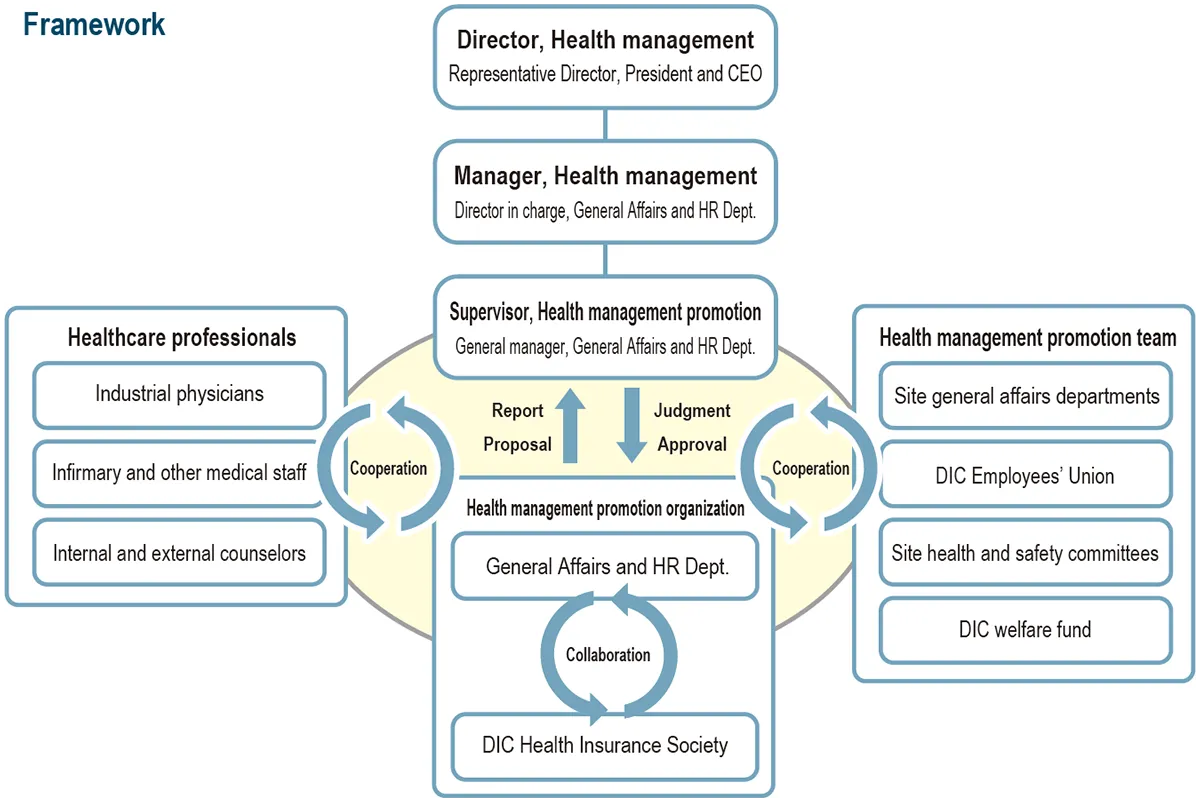
Framework for Promoting Health Management
The DIC Group in Japan promotes health management through a framework based on collaboration with the DIC Health Insurance Society that is under the supervision of the president and CEO. Going forward, the Group will step up collaboration with related organizations to promote effective health management initiatives.
Health Management Strategy Map
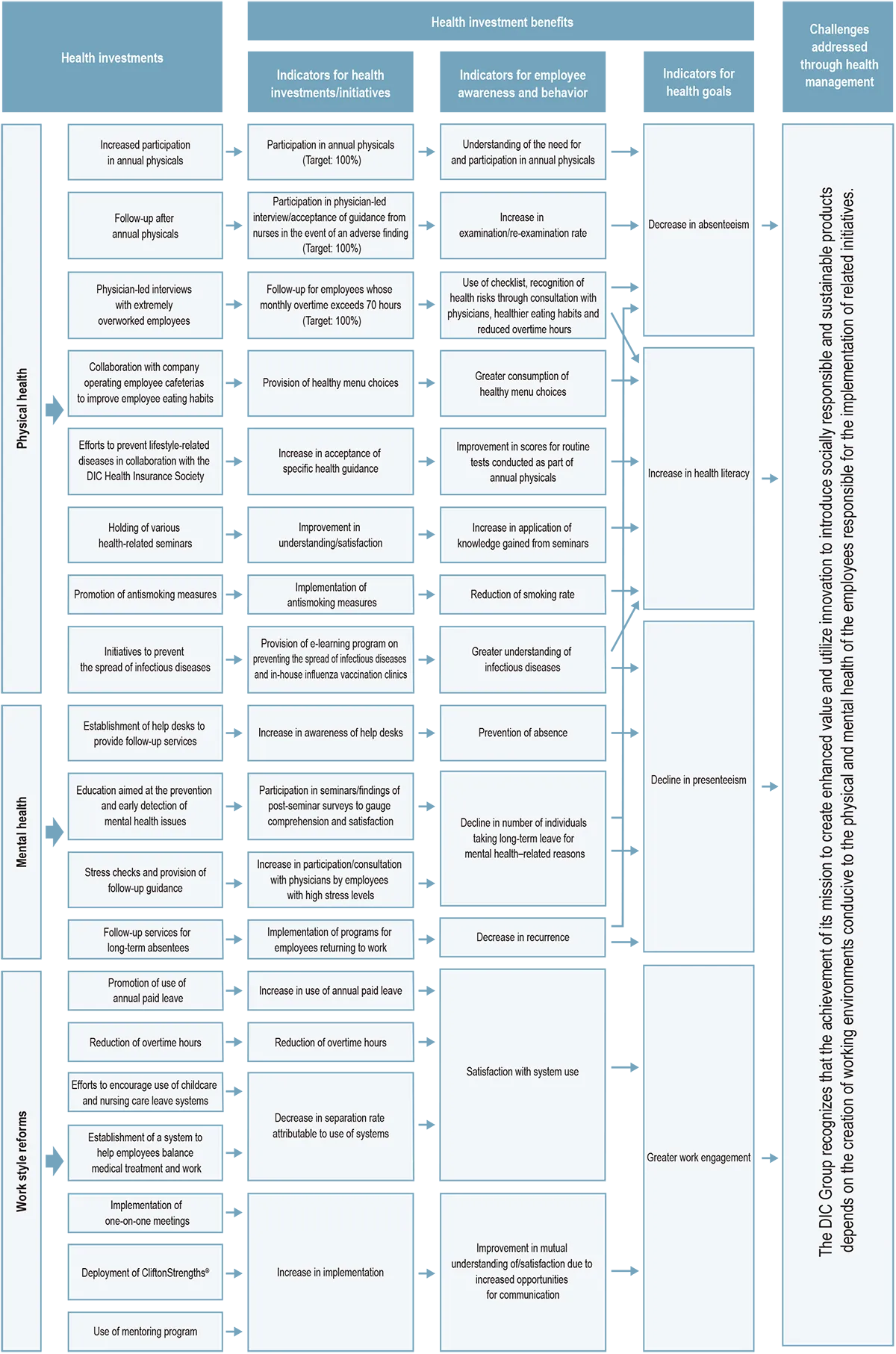
Key Health Management Initiatives
| Category | No. | Initiative | Goal | Details |
|---|---|---|---|---|
| Employee health | 1 | Increased participation in annual physicals | Prevention of serious illness through early detection | Annual physicals help medical staff grasp changes in physical condition and provide appropriate guidance. Target for percentage of employees participating in annual physicals: 100% Fiscal year 2023: 100%, fiscal year 2022: 99.9% |
| 2 | Follow-up after annual physicals | Prevention of serious illness and job separation through early detection/consultation with physicians | Based on the results of annual physicals, industrial physicians and nurses extend guidance on health maintenance, encourage further examination in the event of adverse findings and provide directions on the prevention of lifestyle-related diseases. Target for percentage of employees undergoing thorough examinations: 100% Fiscal year 2023: 74.9%, fiscal year 2022: 68.7% (Note: Certain calculation methods were adjusted in fiscal year 2022) |
|
| 3 | Support for employees returning after taking leave due to illness | Prevention of prolongation, recurrence and job separation | Attending physician, industrial physicians, nurses, workplace colleagues and HR staff work together to support a smooth return to work for employees from leave. Target for percentage of employees taking leave again: 0% Fiscal year 2023: 3.6%, fiscal year 2022: 4.8% |
|
| 4 | Physician-led interviews with extremely overworked employees | Reduction of overwork and management of health risks | Efforts are ongoing to prevent the onset of brain and heart disorders by implementing more stringent management of employee working hours than is called for in standards governing long working hours set forth in Japan's Industrial Safety and Health Act, namely, by setting the threshold for overtime to be considered overwork at 70 hours/month, and by encouraging early consultation with physicians. (Percentage of employee overtime exceeding 80 hours /month) Fiscal year 2023: 0%, fiscal year 2022: 0% |
|
| 5 | Collaboration with company operating employee cafeterias to improve employee eating habits | Prevention of lifestyle-related diseases (including for family members) | Active efforts are made to support employee health by offering healthy menu choices and providing dietary education, including information on improving eating habits. (Percentage of employees with HbA1c levels above 5.6%: Target below 20%) Fiscal year 2023: 19.4%, fiscal year 2022: 21.5% |
|
| 6 | Efforts to prevent lifestyle-related diseases in collaboration with the DIC Health Insurance Society | Awareness of health risks and prevention of serious illness | Based on the results of annual employee physicals, the DIC Health Insurance Society and DIC collaborate to make recommendations to those requiring guidance. | |
| 7 | Holding of various health-related seminars | Improvement of productivity through the maintenance and improvement of health | Efforts focus on promoting employees’ health awareness, including for their families, through the organization of seminars on common health issues, webcasts of past seminars, as well as on women’s health management. (Percentage of employees participating) Fiscal year 2023: Up 9% from fiscal year 2022 (average rate of satisfaction: 87.4%) |
|
| 8 | Staging of various events | Stimulation of communication; improvement of productivity through the maintenance and improvement of health | Various events are staged to promote health maintenance and improvement, including sports tournaments, vascular age measurement events, walks and family site tours. |
|
| 9 | Efforts to encourage regular exercise | Improvement of productivity through the maintenance and improvement of health; prevention of injuries | Various activities are encouraged, including radio calisthenics, exercises to reduce lower back pain and stretching exercises, before starting work and during the day. Fiscal year 2023: 70%, fiscal year 2022: 70.8% |
|
| 10 | Promotion of antismoking measures | Prevention of damage to health and loss of productivity attributable to smoking | Antismoking measures seek to prevent exposure to secondhand smoke, promote awareness of the risks of smoking and support employee efforts to quit smoking with the goal of reducing the percentage of employees who are smokers. Target for percentage of employees who are smokers: 12% Fiscal year 2023: 20.7%, fiscal year 2022: 21.5% |
|
| 11 | Initiatives to prevent the spread of infectious diseases | Improvement of productivity through realization of comfortable work environments; prevention of mental health issues | Efforts are ongoing to prevent the spread of infectious diseases, including the implementation of mass inluenza vaccination clinics and the provision of a related e-learning program. |
|
| 12 | Dissemination of health-related information through health- focused newsletter | Improvement of productivity through realization of comfortable work environments; prevention of mental health issues | Nursing staff from DIC's Healthcare Office and infirmary issue health-related newsletters and work to disseminate health management information that relects the uniTue characteristics of each site. | |
| Mental health | 13 | Education aimed at the prevention and early detection of mental health issues | Helping ensure the happiness of employees and their families; improvement of productivity through the maintenance and improvement of health | Industrial physicians actively conduct rank-specific and self-care training designed to prevent and swiftly detect mental health issues. Target for percentage of employees taking leave: Below 0.5% Fiscal year 2023: 1.1%, fiscal year 2022: 1.0% |
| 14 | Stress checks and provision of follow-up guidance | Improvement of productivity through realization of comfortable work environments; prevention of mental health issues | Stress checks are conducted even at Group companies not legally required to do so. Following checks, individuals discovered to have a high level of stress meet with doctors and where appropriate participate in training provided by industrial physicians specializing in mental health, among others. Target for percentage of employees undergoing stress checks: 95% or higher Fiscal year 2023: 97.2%, fiscal year 2022: 95.8% Target for percentage of employees with high stress levels: 10% or lower Fiscal year 2023: 11.7%, fiscal year 2022: 12.3% |
|
| Work style reforms | 15 | Promotion of use of annual paid leave | Improvement of productivity through realization of comfortable work environments; prevention of mental health issues | Efforts are ongoing to create an environment that makes it easy for employees to take paid leave, and include recommending appropriate timing for leave and having employees plan leave dates. (Average number of days of annual leave taken/employee) Fiscal year 2023: 13.8, fiscal year 2022: 13.4 |
| 16 | Creation of work environments that enable employees to choose lexible working styles | Reduction of mental and physical stress and improvement of productivity | Flexible and efficient working styles leveraging lextime and telework were promoted to curb overtime work. (Average monthly hours of overtime/employee) Fiscal year 2023: 12, fiscal year 2022: 12.4 |
|
| 17 | Efforts to encourage use of childcare and nursing care leave systems | Prevention of job separation because of childcare or nursing care responsibilities | Use of leave systems is being promoted by a job satisfaction improvement working group as part of the Companywide WSR 2020 project. | |
| 18 | Establishment of a system to help employees balance medical treatment and work | Prevention of job separation because of medical treatment | A system has been established to support employees undergoing medical treatment who wish to continue working, along with guidelines for use of the system. Dedicated help desks have been set up at sites to provide individual consultations. | |
| 19 | Implementation of surveys to facilitate management of indicators | Improvement of employee contentment and productivity through the greater opportunities for communication and job satisfaction | Surveys are conducted regularly at DIC Group companies in Japan to facilitate management of employee engagement and other indicators. (Engagement) Essentially level with fiscal year 2023 (Presenteeism) Down 11.5 points from fiscal year 2022 (measured using the University of Tokyo’s Single Item Presenteeism Question method) |
|
| Other | 20 | Establishment of help desks to provide follow-up services | Improvement of productivity through realization of comfortable work environments | Permanent internal and external help desks have been set up that enable employees to report or seek advice on mental health, harassment or other issues and actively follow up on reported matters. |
- Absenteeism is managed using the absence rate as an indicator.
Mental Health Management Initiatives
The DIC Group in Japan takes steps to create work environments in which employees feel physically and mentally supported. A particular priority is placed on caring for psychological and emotional well-being and the Group has established a comprehensive mental health program, highlights of which include engaging an in-house occupational psychologist, promoting initiatives aimed at warding off mental health problems and extending support to ensure a smooth return to work for employees taking leave. In particular, access to counseling provided by an occupational psychologist has had a considerably positive impact in terms of ensuring employees get treatment and are able to return to work as quickly as possible.
The Group has also offered voluntary stress checks since fiscal year 2013, well before the passage of related legislation in Japan in 2016, as part of an active effort to help prevent mental health disorders. Participation in stress checks is high most years. Based on an analysis of findings, the Group also provides follow-up—including offering self-care training and line care training for supervisors led by a physician specializing in mental health and encouraging individual department heads to speak with industrial physicians—with the objective of making concrete improvements to work environments. The Group will continue to focus on such initiatives going forward.
Mental Health Initiatives
- Guidance from an occupational psychologist
- Internal and external help desks
- Line care training* for newly appointed supervisor
- Mental health self-checks as part of training for new employees
- Creation of new online version of the Kokoro no Kenko (“Psychological Health”) self-check handbook
- Flexible process to support employees returning to work after taking leave
- Line care training: Training for supervisors to help them recognize promptly when an employee is unwell and respond appropriately by, for example, recommending guidance or counseling or making workplace improvements.
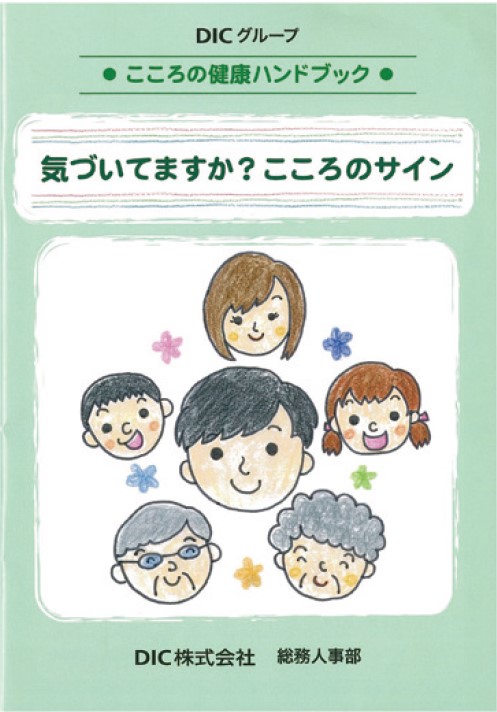
Kokoro no Kenko self-check handbook
TOPICS
DIC Earns White 500 Certification for the Eighth Consecutive Year
DIC and DIC Graphics once again earned certification in the large enterprise category of the 2025 Health & Productivity Outstanding Entities Recognition Program (dubbed the “White 500”), which is organized by the Ministry of Economy, Trade and Industry and Nippon Kenko Kaigi.* This is the eighth consecutive year the companies have been certified under this program, which seeks to shine a spotlight on outstanding enterprises working to advance health and productivity management, creating an environment that ensures such enterprises gain enhanced public recognition—i.e., from employees, related companies and financial institutions—as organizations that approach employee health and productivity from a management perspective and promote strategic initiatives.
DIC and DIC Graphics once again greatly exceeded the industry average for all four criteria used: “Management philosophy,” “organized framework,” “systems and implementation of measures” and “evaluation and improvement.” Specifically, the companies earned high praise for its efforts to create a foundation for effective health management by encouraging work–life balance, including empowering workplaces by strengthening communication and holding information sessions and seminars to encourage better understanding of its childcare and nursing care programs. The companies were also recognized for their efforts to identify health issues by analyzing existing conditions, implementing key measures and making necessary improvements.
- Nippon Kenko Kaigi (“Japan Health Council”) is an organization that liaises with private companies, with the full backing of the government, to put effective measures in place to prolong the healthy life expectancy of citizens and to ensure sound medical services in Japan.
Initiatives to Support Employee Health
DIC analyzes the results of employees’ annual physicals and provides assistance to employees for whom lifestyle improvements have been recommended by providing introductions to hospitals and clinics, and individual guidance on lifestyle improvements. With the aim of promoting healthy eating, the employee cafeteria at DIC’s corporate headquarters in Tokyo offers a heathy cafeteria menu dubbed “DIC Irodori Care+” (“DIC Colorful Care Plus”). DIC’s General Affairs and HR Department, the Healthcare Office and the company responsible for the operation of the cafeteria collaborated to develop this menu based on the health needs of employees. The Company also devised innovative ways of presentation, including producing distinctive signage that encourages recognition and names that clearly communicate the health benefits of menu selections, such as reduced calories or low cholesterol. DIC Irodori Care+ also makes use of familiar meal components like kobachi (small bowl) side dishes transformed into a nutrient-packed “Supplement Bowl” to promote greater awareness of food’s role in improving overall health.
DIC will continue implementing measures to help ensure the physical and mental health of its employees as part of its commitment to creating work environments that empower them to fully realize their potential.

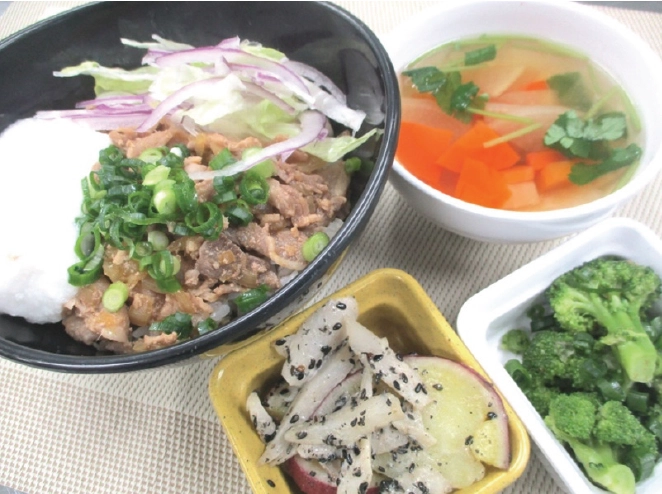
Healthy cafeteria menu selection
