
Six Companies Launch Joint R&D to Build a Quantum-Computing-Based Materials Development Platform
Project selected by NEDO for innovative materials development platforms using quantum technology;
demonstrates practical use cases that integrate quantum computing and AI technologies
- R&D
- News Release

Tokyo, Japan – DIC Corporation (DIC; TYO: 4631), TOPPAN Holdings Inc. (TOPPAN Holdings; TYO: 7911), AISIN CORPORATION (AISIN; TYO: 7259), Asahi Kasei Corporation (Asahi Kasei; TYO: 3407), SoftBank Corp. (SoftBank; TYO: 9434), and AGC Inc. (AGC; TYO: 5201) jointly announced today that their joint proposal, “Research and Development of Innovative Materials Development Platforms Using Quantum Technology” (hereinafter the “Project”), has been selected by the New Energy and Industrial Technology Development Organization (NEDO).1 The Project was chosen under NEDO’s solicitation for the “Research and Development Project of the Enhanced Infrastructures for Post-5G Information and Communication Systems ”.
Following this selection, the six companies entered into a joint agreement to conduct research and development on constructing a new materials development platform utilizing quantum computers from fiscal 2026 (the year ending March 31, 2027) through fiscal 2028. The Project aims to establish a next-generation materials development platform by integrating quantum-computing-based calculations with AI technologies such as machine learning, thereby bridging the gap between demonstration and real-world application.
Background
For Japanese chemical and materials manufacturers to maintain global competitiveness, an urgent priority is to establish technologies that dramatically improve the discovery of new materials as well as development efficiency. In recent years, progress has been made in data-driven approaches—where AI predicts and explores new materials based on historical materials data—as well as computational science simulations based on physical laws. However, while data-driven methods face a challenge in securing sufficient, high-quality, and high-precision training data, computational science faces the issue of surging computational costs for higher accuracy and larger scale calculations.
There is strong optimism for quantum computers operating on the principles of quantum mechanics to address such challenges. Quantum computers have the potential to simulate the properties of molecules and electrons governed by quantum mechanics more efficiently than conventional computers. However, since there are currently limitations in qubit2 count and error rates, large-scale calculations using quantum computers alone are still not a reality.
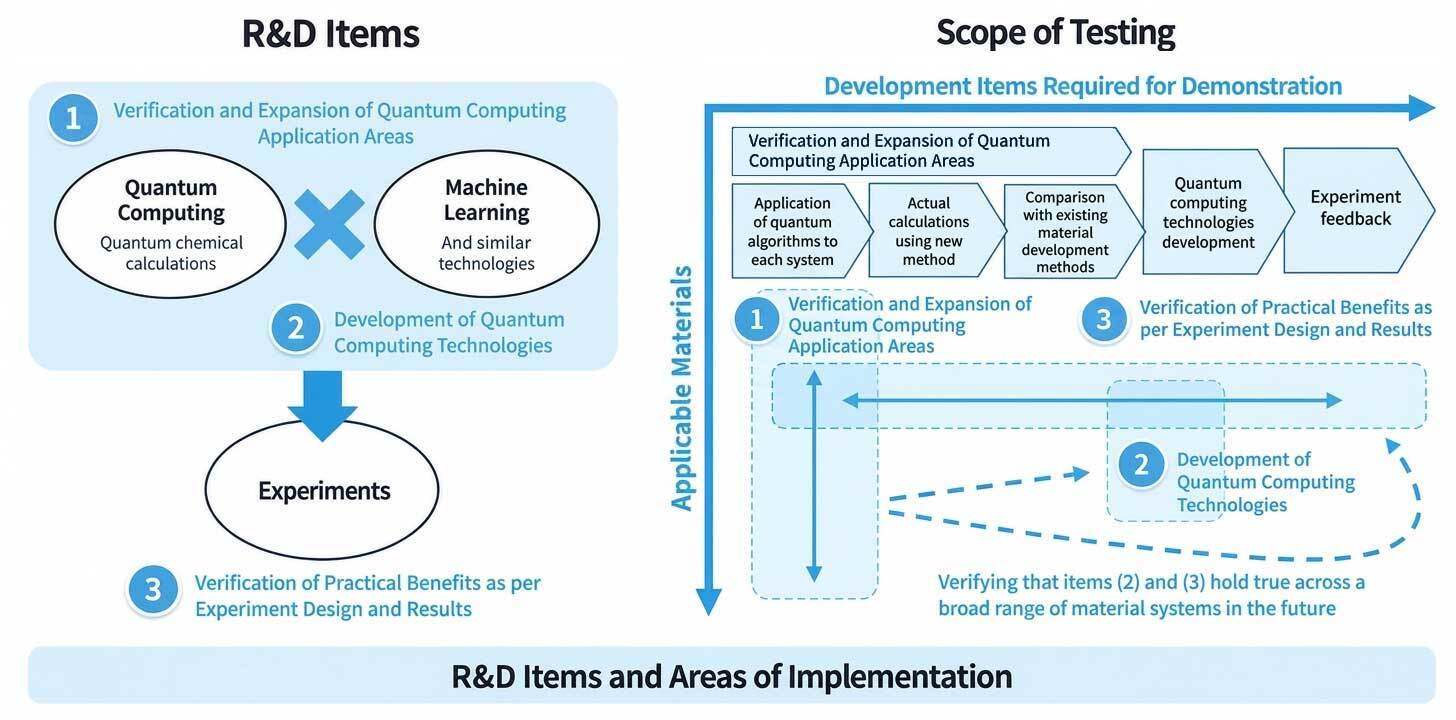
To overcome these hurdles, the Project will establish a methodology that combines quantum-computing-based calculations with AI, mitigating constraints on calculation precision and scale. Rather than targeting a single specific material, the materials development technologies will be applied cross-sectionally across a broad range of industrially vital materials systems, with each of the six companies handling verification in their respective domains of strength. In addition, through collaboration with specialized quantum computing institutions, the companies will advance applicability verifications across diverse materials while working together to create practical value for industrial application.
Overview of the Project
1. Verification of Quantum Computing Application Areas
Verify the applicability of quantum computing for numerous major materials with high industrial demand, including materials required for next-generation batteries, optical functional materials for new displays and sensors, and superconducting materials for next-generation devices.
2. Development of Quantum Computing Utilization Technologies
Develop technologies that integrate quantum-computing-based calculations with AI to expand the scope of computational methods and verify solutions to scale and cost limitations inherent in conventional computing methods.
3. Simulation Demonstration and Experiment Feedback
Synthesize materials and evaluate their performance based on simulation results (including those using quantum computing) and compare experiment results against simulation data to improve predictive accuracy and verify the benefits of practical application of quantum computing.
Roles of Participating Companies
TOPPAN Holdings
Execute hybrid methods combining quantum and classical algorithms on quantum computers for additive materials to verify quantum computing application; develop combined quantum computing and AI methods; provide experiment feedback.
AISIN
Verify quantum computing application for superconducting materials; compare results with conventional material development methods; forecast practical implementation timelines in material development environments.
Asahi Kasei
Verify platforms utilizing quantum computing for materials development through applicability studies of quantum computing to organic compounds (such as electrolytes), polymer materials, and inorganic materials (such as electrodes), combined with feedback from experimental results.
SoftBank Corp.
Utilize a computing platform connecting quantum computers with supercomputers to generate high-level data useful for material development, along with developing data utilization technologies using AI; carry out demonstrations to optimize material development across diverse domains, including energy-related materials such as next-generation batteries.
AGC
Develop and evaluate material development methods combining quantum computing with existing computational science and AI technologies for inorganic materials (such as optical glass) and organic materials (such as electronic materials); derive insights and establish design guidelines to enhance materials exploration and design.
DIC
Integrate quantum computing, simulation, and data science technologies to predict key material properties prior to synthesis for colorants and semiconductor materials, while establishing and validating novel research methodologies that accelerate the efficient design and development of high-performance materials.
Future Steps
By combining data on quantum computing and AI with the experimental data obtained through the Project, the six companies will work toward constructing a continuously evolving materials development platform, contributing to the creation of cross-industry innovation.
1 For details on the call for proposals and selection results, please visit: https://www.nedo.go.jp/koubo/CD3_100424.html (in Japanese)
2 A qubit is the fundamental unit of quantum information in quantum computing.