
DIC Wins 2025 Japanese Society of Tribologists (JAST) Best Technology Award —This award recognizes DIC’s proprietary nanosized MoS2 lubricant additive—
- R&D
- News Release

Tokyo, Japan—DIC Corporation today announced that it has been named a winner in the 2025 JAST Best Technology Awards for its functional nanosized molybdenum disulfide (MoS2) lubricant additive, developed using its proprietary inorganic materials design technology.
As published in the Journal of Japanese Society of Tribologists, Volume 71, Issue 4, (pages 259–262), released via J-STAGE on April 15, 2026, DIC Corporation has been selected as a winner of the 2025 Japanese Society of Tribologists (JAST) Best Technology Award for its original research and development on the “Synthesis of Novel Nanosized Molybdenum Disulfide and Its Application to Solid Lubricants,” led by award recipients Fumiaki Kodera, Jianjun Yuan, PhD, and Siti Masturah Fakhruddin, PhD.
The Japanese Society of Tribologists is a leading organization in Japan specializing in friction, wear and lubrication research, making this a significant accolade for chemicals and materials manufacturers. The prestigious JAST Best Technology Award honors outstanding technological contributions to tribology—the branch of engineering related to friction, wear and lubrication—and acknowledges practical solutions that demonstrate originality and high functionality, with the promise of contributing to society in the future. Receiving this award is a recognition of DIC’s outstanding advancements in friction-reducing and materials-enhancing technologies.
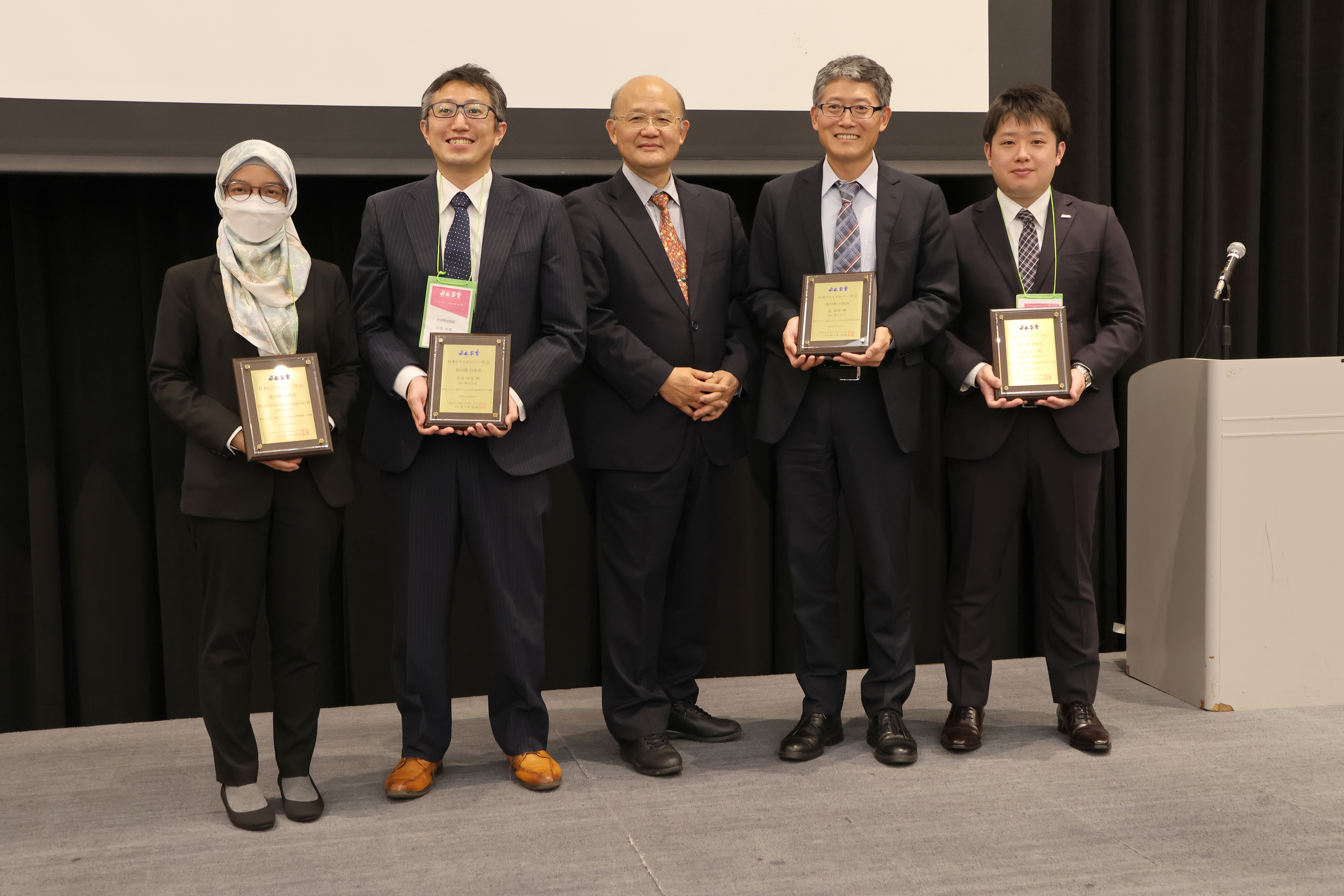
Award recipients and project members involved in the development of DIC-MoS2 solid lubricant additive technology, including DIC employees Siti Masturah Fakhruddin (far left), Fumiaki Kodera (second from left), and Jianjun Yuan (second from right)
Dr. Tatsuya Shigehiro, Manager of the ESI Group at DIC’s Central Research Laboratories, who serves as the project manager for the development and performance evaluation of DIC’s nanosized MoS2, including its use as a solid lubricant additive, noted the outstanding achievement and described the company’s success in gaining this award as another sign of DIC’s ongoing commitment to advancing the science behind friction-reducing and materials-enhancing technologies.
The Significance of This Development
This development of DIC’s novel nanosized MoS2 addresses the growing demand for high-performance lubrication technologies that support carbon neutrality, improved energy efficiency and longer service life for mechanical components. As industrial machinery, automotive systems, robotics and precision equipment become smaller and more sophisticated, reducing friction and wear in narrow sliding interfaces is increasingly important. Dr. Shigehiro explains, “While MoS2 has long been used as a solid lubricant, current materials may not always deliver sufficient performance, depending on the application. The newly developed nanosized MoS2 in sheet form is designed to improve access to and retention at sliding interfaces, enabling higher lubrication performance where existing materials may be limited.”
What Distinguishes DIC-MoS2 from Commercially Available MoS2
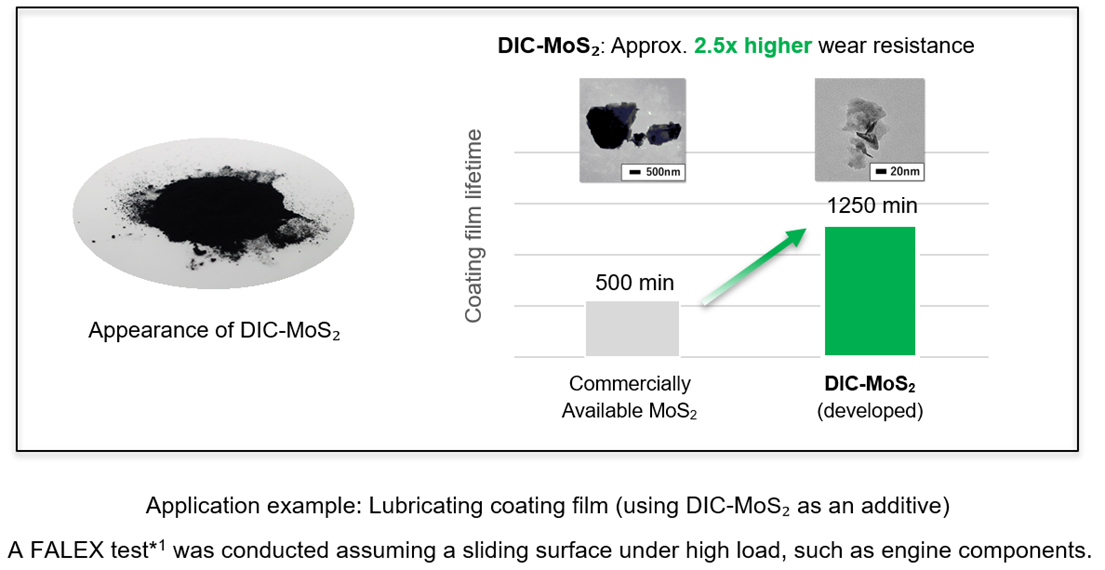
Unlike commercially available MoS2, the award-winning DIC-MoS2 is a nanosized, sheet-form molybdenum disulfide particle prepared through a proprietary bottom-up manufacturing process. Dr. Shigehiro adds, “This process enables high purity and fine particle size, while the material’s distinctive 3R crystal structure is considered advantageous for lubrication performance. In solid lubricant coating evaluations, DIC-MoS2 demonstrated significantly improved durability compared with coatings using commercial MoS2 alone.”
“Moreover, FALEX testing showed that coatings containing DIC-MoS2 achieved approximately twice the durability of those using only commercial MoS2. In addition, replacing a portion of commercial MoS2 with a small amount of DIC-MoS2 also improved coating durability, indicating the potential to enhance performance even at low addition levels.”
Primary Markets for Novel Nanosized MoS2
DIC-MoS2 can be used in applications such as coatings, greases, oils and compounds, where even a very small amount is expected to provide excellent lubricating performance without compromising the properties of the base material. Dr. Shigehiro notes, “This makes it a promising option for high-value-added applications that require both material property retention and superior sliding performance, as well as for applications seeking perfluoroalkyl or polyfluoroalkyl substance (PFAS)-free solutions. Potential areas of application range from extreme environments, such as cryogenic and high-vacuum conditions represented by outer space, to robotics fields that require highly precise movement, particularly in humanoid robots.”
– Ends –
*1 A high-load lubrication test based on ASTM standards, which are widely used technical standards developed by ASTM International, offering high objectivity and reproducibility.