
DIC Develops PPS Compounds with Excellent Tracking Resistance for Increasingly High-Voltage and Downsized Electrical Components
―One compound achieves high tracking resistance (CTI 600 V) and the other
provides both tracking resistance (CTI 200 V) and heat cycle resistance―
- Business & Product
- News Release

Tokyo, Japan—DIC Corporation announced today that it has developed two polyphenylene sulfide (PPS) compounds—DIC.PPS TX-2010-HV BLACK and DIC.PPS Z-650-MV BLACK*1—that achieve superb tracking resistance,*2 fulfilling the performance requirements of increasingly high-voltage and downsized electrical components used in electrified vehicles (xEVs), as well as in electrical and electronic equipment.
DIC.PPS TX-2010-HV BLACK achieves high tracking resistance (comparative tracking index (CTI) 600 V). This reduces the creepage distance necessary for high-voltage component insulators, enhancing insulation design flexibility and allowing the production of smaller, space-saving components. DIC.PPS Z-650-MV BLACK combines tracking resistance (CTI 200 V) and heat cycle resistance. Because it maintains stable performance even under repeated temperature fluctuations, this compound is particularly suitable for metal insert components, including busbars and terminal blocks.
These two new PPS compounds enable customers to make material selections based on the particular performance requirements of the specific application, thereby supporting the downsizing and improved reliability of high-voltage electrical components.
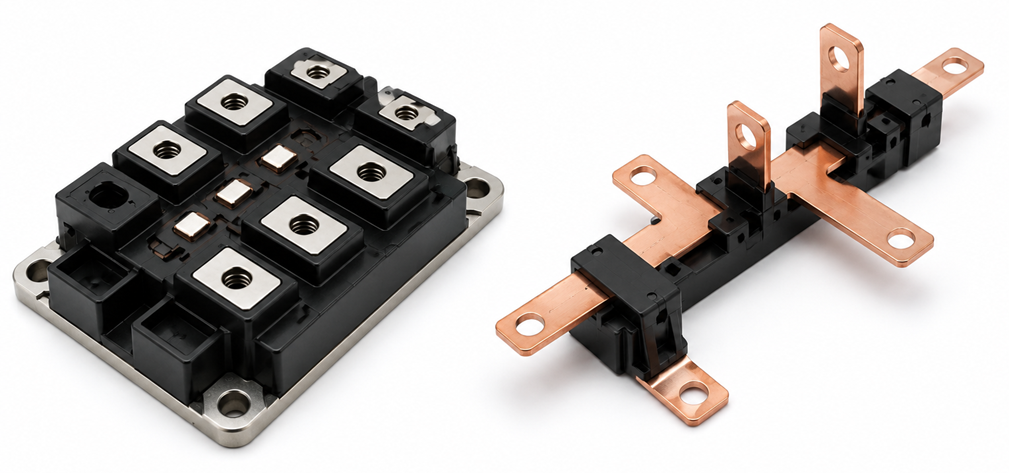
Examples of intended applications (Power module (left) and busbar (right))
Overview of the New Products
-
CTI 600 V CTI 200 V Product name DIC.PPS TX-2010-HV BLACK DIC.PPS Z-650-MV BLACK CTI 600 V 200 V Principal features High tracking resistance Tracking resistance and heat cycle resistance Value provided Enhanced insulation design flexibility, component downsizing and space savings Improved long-term reliability of metal insert components Applications Power modules and other high-voltage electrical components Busbars, terminal blocks and other metal insert components
Background to development
In recent years, the growth of xEVs and advances in the performance of power electronics have driven a shift to electrical components, such as inverters, power modules, and busbars, that are compatible with higher voltages and currents. At the same time, demand is growing for increased component density to improve driving range and to simplify installation. These trends are driving the need for materials that ensure reliable insulation in smaller spaces.
PPS is a high-performance engineering thermoplastic that offers excellent heat and chemical resistance, dimensional stability, and mechanical properties, and is used extensively in electrical components for automobiles and industrial equipment. Given the increasingly high voltages of electrical components, high tracking resistance is crucial to suppress the degradation of insulation caused by discharges on the insulator material surface. Materials with excellent tracking resistance shorten the creepage distance required for insulators, enhancing insulation design flexibility and facilitating greater component downsizing. For metal insert components such as busbars and terminal blocks, prolonged reliability—specifically the ability to withstand repeated temperature changes in automotive environments—is also a major factor. Finding a balance between tracking resistance and heat cycle resistance was therefore essential.
Leveraging its PPS resin design and advanced compounding technologies, and to address this challenge, DIC has developed two new PPS compounds, one that achieves high tracking resistance (CTI 600 V) and the other that delivers both tracking resistance (CTI 200 V) and heat cycle resistance. These new products have expanded the Company’s high-value-added materials for increasingly high-voltage, downsized and reliable electrical components for automotive applications.
Key features of the new products
1. DIC.PPS TX-2010-HV BLACK: High tracking resistance contributes to greater miniaturization of electrical components
This compound achieves high tracking resistance, with a CTI of 600 V (equivalent to performance level category (PLC*3) rank 0). This material also provides flame retardance equivalent to the V-0 level in UL 94*4 compliance testing, as well as mechanical properties and molding flowability comparable to those of general-purpose filled PPS resins. High tracking resistance shortens the creepage distance necessary for high-voltage component insulators, enhancing insulation design flexibility and allowing the production of smaller, space-saving components.
2. DIC.PPS Z-650-MV BLACK: Combination of tracking resistance and heat cycle resistance improves the reliability of metal insert components
This compound combines tracking resistance of CTI 200 V with heat cycle resistance, making it able to withstand repeated temperature fluctuations. This ensures the stable performance of metal insert components, including busbars and terminal blocks, over long periods of time, contributing to the high level of reliability required for automotive applications.
3. Lineup that enables customers to make material selections based on their particular needs
DIC.PPS TX-2010-HV BLACK is well suited for applications that demand high tracking resistance, while DIC.PPS Z-650-MV BLACK addresses the need for both tracking resistance and heat cycle resistance. These two offerings, with their different performance features, enable customers to make material selections based on their particular requirements. Such features, as well as the PPS’ excellent heat and chemical resistance, and dimensional stability, support use in a broad range of increasingly high voltage and downsized electrical components.
Outlook
Looking ahead, DIC will continue to market these two innovative products to the automotive, industrial equipment, and electrical and electronic equipment markets. The Company will also work to further expand its selection of offerings to meet the specific performance specifications of different applications. Of particular note, in the area of materials for mobility solutions, including xEVs, efforts will focus on the development and deployment of high-performance, high-value-added PPS compounds that respond to diverse requirements, including the ability to endure higher voltages, as well as to enhance the flexibility of insulation design and ensure long-term dependability.
*1 DIC.PPS Z-650-MV BLACK will initially be introduced to the European market. Please contact DIC for information on availability in other regions.
*2 Tracking occurs when voltage is applied to an insulating material in a state where moisture or contaminants are present on the material’s surface. CTI is an index of a material's resistance to tracking, with a higher CTI value indicating greater tracking resistance.
*3 PLC (Performance Level Category) is a classification used to categorize tracking resistance performance. PLC 0 is the highest category.
*4 UL 94 is a plastics flammability standard released by Underwriters Laboratories of the United States. V-0 is a classification indicating a high level of flame retardance.
―Ends―