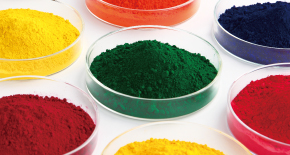
We offer pigments and pigment dispersions suitable for a wide range of printing processes, including offset, flexographic, and gravure printing. Our portfolio is designed to meet key performance requirements such as shade and color strength, dispersibility, weatherfastness, and safety for food-contact and toy applications.
Overview of pigments for printing inks
What you can find on this page
Performance requirements by printing process: shade and color strength, lightfastness, rub resistance, scratch resistance, and more
Substrates and applications: paper (uncoated / coated), films (OPP, PET, PS, PVC), metal, glass
Safety and regulations: food-contact and toy applications, NIAS considerations, compliance with relevant legislation
Technical support: selection based on Color Index, alternative proposals, provision of SDS and technical documentation
We offer a broad portfolio of organic pigments (and selected inorganic
pigments), effect pigments and dispersions, providing the optimal
colorants for each printing process and application. Our focus on raw
material selection and our global supply network help ensure consistent
quality, safety and compliance with a wide range of regulations.
Broad portfolio
Organic pigments (and selected inorganic pigments) and pigment
dispersions optimized by application
Product selection based on representative Color Index references
Lineups tailored to a wide range of printing systems including
offset, flexo, gravure and screen
High quality consistency
Careful raw material selection to minimize impurity-related risks
Stringent quality control supported by a global quality assurance
framework
Particle size control and surface treatment technologies
Proprietary technologies enabling product recommendations designed
for compatibility with a wide variety of vehicle systems
Controlled particle size to balance high tinting strength with
excellent printability
Compliance with regulations and local laws
Extensive range of products designed for safety-critical
applications such as food-contact and toys
Active engagement with country- and region-specific laws and
regulations
We offer products that address regulatory requirements and application needs, including food-contact applications, and support product selection for each intended use.
High clarity, anti-bleed and regulatory compliance
Designed to deliver strong adhesion and color development on film substrates
(OPP / PET / PS, etc.) while controlling bleed. For food-contact related
areas, we offer designs and proven performance that take various safety
requirements into account.
Industrial printing (containers / metal / building materials / forms ruling)
Focus on weatherability, chemical resistance and adhesion
Pigments are designed with core requirements such as weatherability,
chemical resistance and adhesion in mind, while covering a wide
variety of substrates including metal, containers and building
materials. For decorative effects, we can also propose metallic and
effect finishes using effect pigments and aluminum pigments.
Effect pigment lineup to enhance design appearance
We also offer an extensive portfolio of effect pigments that enhance
visual impact and design appearance. For mirror-like effects in
packaging applications, we recommend vacuum-metallized aluminum
pigments.
※ All product names shown on this page are trademarks owned by the DIC Group.
Pigment search tool banner
Information on over 2,000 pigments
in a single pigment search system
Pigment Finder is an online platform operated by Sun Chemical that
covers the full range of products handled by the DIC Group.
Pigment Finder provides easy access to detailed pigment information.
This section summarizes the most common inquiries we receive regarding
pigments for printing inks.
Total 0 items / Showing 0 items
For each printing process such as offset, flexographic, gravure, and
screen printing, pigments must be selected that provide the required
performance during printing as well as the necessary properties in
the final printed application.
In addition to differences in ink formulation and use conditions by
printing process, pigments are selected based on their chemical
structure considering the required performance of the final print.
Recommended grades are selected according to the specific
characteristics of each product.
Based on the printing method (process), printing substrate, and
required performance of the final application, Color Index is
selected by comparing color, tinting strength, dispersibility,
compatibility, lightfastness, heat resistance, water resistance,
cost, and other relevant factors.
From the standpoint of Food Contact Compliance and management of
NiAS (Non-intentionally Added Substances), we can support a wide
range of customer inquiries. For details, please contact our product
sales representatives.
Yes, they can.They can be used in various ways, for example to give
special decorative effects. However, depending on the ink
formulation and printing conditions, it is necessary to optimize the
conditions for your specific formulation. Please adjust each
parameter within your ink formulation.
After confirming details such as your specific application and
required quality, we can provide small-scale evaluation samples and
standard documents such as SDS.
Packaging unit size, minimum lot, and lead time differ by product.
Please contact our sales representatives for details.
Store in tightly closed containers at room temperature, avoiding
direct sunlight and high temperature or high humidity. Shelf life
varies by product, so please contact your sales representative for
details.
Abbreviations & Terminology Guide
This is a brief guide to abbreviations frequently used on this site. Details are explained in each content section.
Color Index (CI)
C.I. (Color Index) is an international standard reference that systematically organizes and classifies colors, jointly maintained by SDC (Society of Dyers and Colourists, UK) and AATCC (American Association of Textile Chemists and Colorists, US). For pigments, designations are written as “Pigment + color name + number”.
PR / PY / PB / PG
Abbreviations for Pigment Red / Yellow / Blue / Green. Examples: PR122 (quinacridone type), PB15:4 (phthalocyanine type).
Food Contact Compliance (FCC / FCS)
Compliance documentation according to the country of sale and contact conditions. Details depend on the specific application and conditions.
NiAS (Non-intentionally Added Substances)
Non-intentionally added substances. In package printing and other applications, they can be one possible cause of bleed, sometimes affecting quality, and in some cases raising concerns about the safety of residual substances.
Metallic effects (Metallics / Pearlescent)
Effect achieved by using effect pigments such as aluminum or pearlescent pigments, either alone or in combination with colored pigments, to enhance decorative appearance.


 Broad portfolio
 High quality consistency
 Particle size control and surface treatment technologies
 Compliance with regulations and local laws
 Technical support